Speech
By Emmanuel Macron
September
14th Palais de l’Élysée
Madame Julia
Kristeva—
On behalf of the
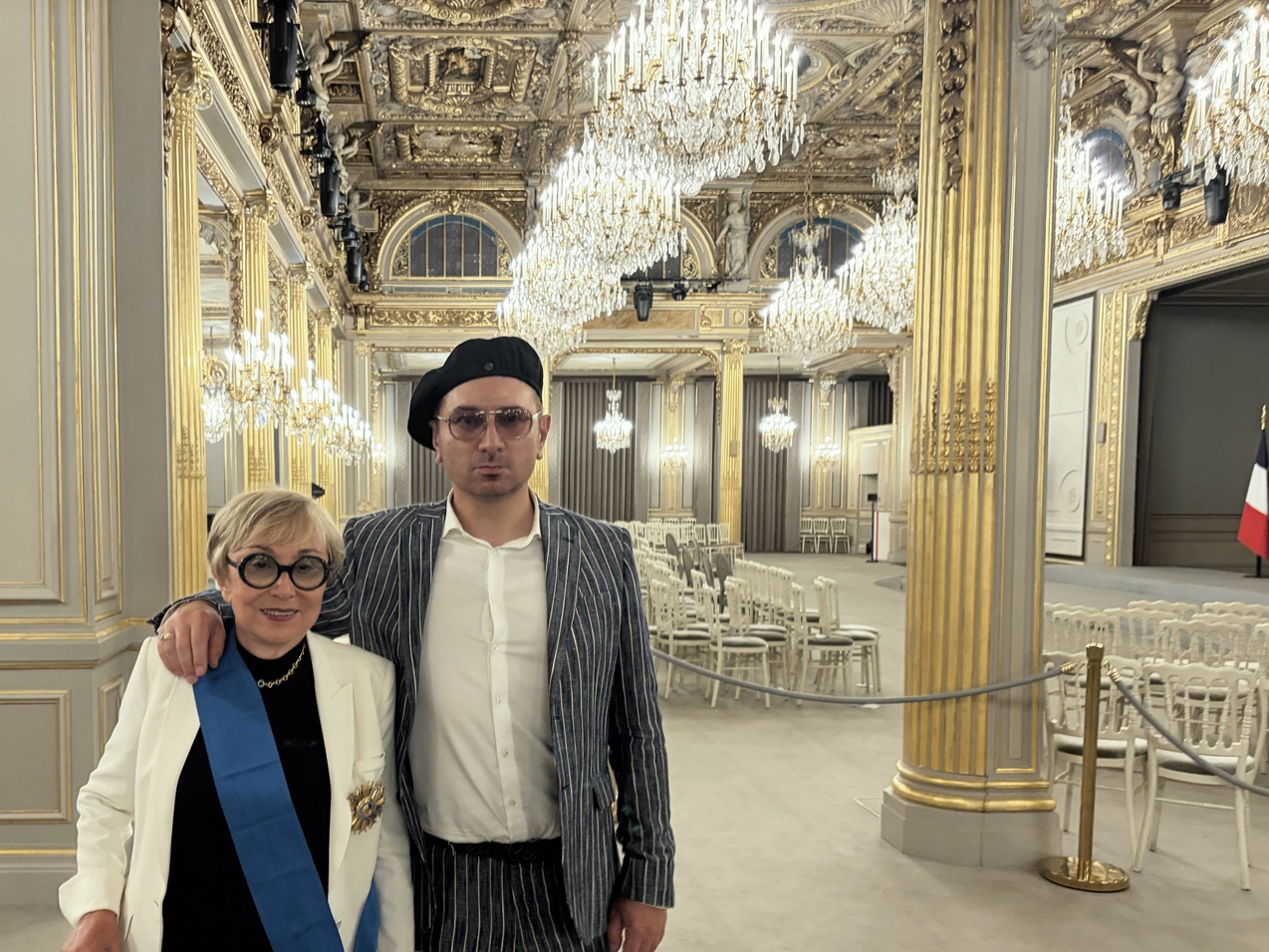
French Republic, we raise you to the dignity of the Grand Cross of the National
Order of Merit.
Dear Julia
Kristeva,
Your
life could be summed up in one word: to translate. You have translated
words that already existed within you, turned them into volumes, and helped so
many others to find their own words. Through writing, reading, and reflection, you
have made a fine art of translation
And
for you, indeed, it all started with letters.
You
were born in Silven, Bulgaria, and your childhood memories are colored by those
unique celebrations of May 24th, when the alphabet is paraded in the
streets of your city. A
letter of the Cyrillic alphabet was pinned to your clothing. This was a call to
write that was unrelated to any literature. And you even recalled having the
feeling of becoming this letter. It was from the experience of this
joyous celebration that you came to treasure a lesson that writers, artists,
and lovers of letters then shouted in the streets: “Le verbe ne fait que
s’éscrire en moi pour que le bien soit” [“The Word writes itself in me only
so the good exists”]. This
saying remains with you, as with your intimate bond with words. Already
a sensitivity, an awareness that the misnaming of things is a serious matter. And
so, between the spirituality of your father, an accountant with the church
administration, and the rationalism of your mother, a biologist, you chose for
yourself the Enlightenment, a French Enlightenment, passionately French. You attended L’alliance française, learned French, and you copied from
Diderot’s Jacques the Fatalist or Voltaire’s Philosophical Dictionary,
to forget, from time to time, the violence that surrounded you. But you are no
child of the nomenklatura, and so you could not go to Moscow to pursue the course of studies in Astronomy
that you dreamed of. And so, at the University of Sophia you turned to
literature.
You
were 24 when the Charles-de-Gaulle Scholarship brought you to France. You had
five francs in your pocket, but [also] this love of letters, language, and
words. It happened in Paris when you were reading the magazine Clarté in
a tiny room that you came across a picture of one Philippe Sollers [1936-2023].
His literary vision interested you as much as his appearance, which struck you
more as that of a footballer than a writer. And so, you went to meet him, and
it was like a vision, or a confirmation, that you had already decided, without a
doubt, that you would never again part ways.
As a young intellectual you are poised
to leave an impression on the world of ideas both in France and abroad. Nourished
by poststructuralism, I struggled to say, you forged above all your own
thought, a path, and in constructing this thought you made friendships with
some of the biggest names in the French intellectual scene. Following your
noteworthy research on the medieval novel, it
is with your doctoral thesis, Revolution in Poetic Language, that you cross frontiers, where you theorize that which you will call
“semiotics,” this part of language that precedes sense, a fascinating field of
studies that will take you to question the nature of Giotto and Bellini’s
paintings and the literature of [Mallarmé,] Artaud, Joyce, Céline and Proust.
And from China to the United States, you became a key figure in contemporary
thought.
You
are situated at the intersection of several intellectual currents:
structuralism, historical materialism, and psychoanalysis. From this confluence
emerges overall a unique approach that allows you to help create, in France and
abroad, this notion of intertextuality. Every text, you say, is constructed as
a mosaic of quotations and an interlacing of words ‘already said’ and taken up
anew. And speaking of the déja-dits, Roland Barthes—and you would later
give his name to your research center—said
of you that you have this ability to displace the already said. And how fitting, because your entire body of work is indeed a matter of
displacement, of singularity, of otherness. A
sense of otherness that stems moreover from this feeling of being at once
French, Bulgarian, and European, and you are among those who think of Europe in
terms of language, convinced that writing and creation can serve, precisely, to
unite us.
Julia Kristeva, this ‘will to know,’
but also to transfer and disseminate enlightenment knowledge. Through your
teaching, you have marked entire generations of students. Through your lectures
on psychoanalysis, you have also established yourself as an intellectual
authority for an entire generation. It is said in the United States that you
are not only a star, but that during your stays in Washington or New York it
was not uncommon for people to ring the doorbell asking to see mister and
misses Kristeva. You have always shared. And books have sustained your
life with Philippe, even the rooms of your homes are overflowing with books,
nourishing this literary bond that has never left you. Then your son David, the
joy of your life since 1974. Here again culture brightened your lives: Philippe
made young David laugh as the family’s Molière, as
Mozart’s music often filled the living room. Together you shared so many
struggles and convictions.
You
decided in 2003 to commit yourself to establishing, along with Charles Gardou
[b. 1953], the Conseil National Handicap (CNH), to raise
awareness, provide training, and share information about different forms of
disability and their treatments. You found yourself at a loss at times, confronted with the incomprehensible.
And then it was David who found the words, Cartesian as he was, “But mom! I
dream, therefore I am!” You continued to be there for your family, in the
‘service of letters,’ of thought, and until his last breath, at the end of The
Second Life, alongside Philippe. It was David who, in a moment of brilliance, at the event of his father’s
passing, created this magnificent word so full of promise: démourir. In
the breeze of the Isle of Ré near the section of the Cimetière d’Ars
dedicated to British Airmen is where the love of your life rests, this second
life, and it is yours too.
“I travel myself” [Je me voyage], you say. By your books and your lectures, and your
dedication to your patients, you have undoubtedly turned your life into a fine
art.
To
this day you are steadfast to your loved ones, to the ‘service of letters,’ to
thought, and to continuing your work that has always brought together
languages, disciplines, and cultures, from Bulgarian to French, from
psychoanalysis to literature, seeking what we share in common, but always
assuming this great singularity—“to displace the already said.”
And so, dear Julia, for all of these
reasons, as well as those that I have not mentioned, I have the honor of
elevating you to the rank of the Grand Cross of the National Order of Merit.
Emmanuel Macron
(The spoken word shall prevail)
Translated
by Ilya Merlin.